Seasonal Storage Ideas for Small Homes
Seasonal storage ideas for small homes, apartments, closets, and under-bed bins so off-season items stay easy to find.
By Steve Watts · Co-Founder, Totely
May 5, 2026 · Updated June 6, 2026 · 14 min read
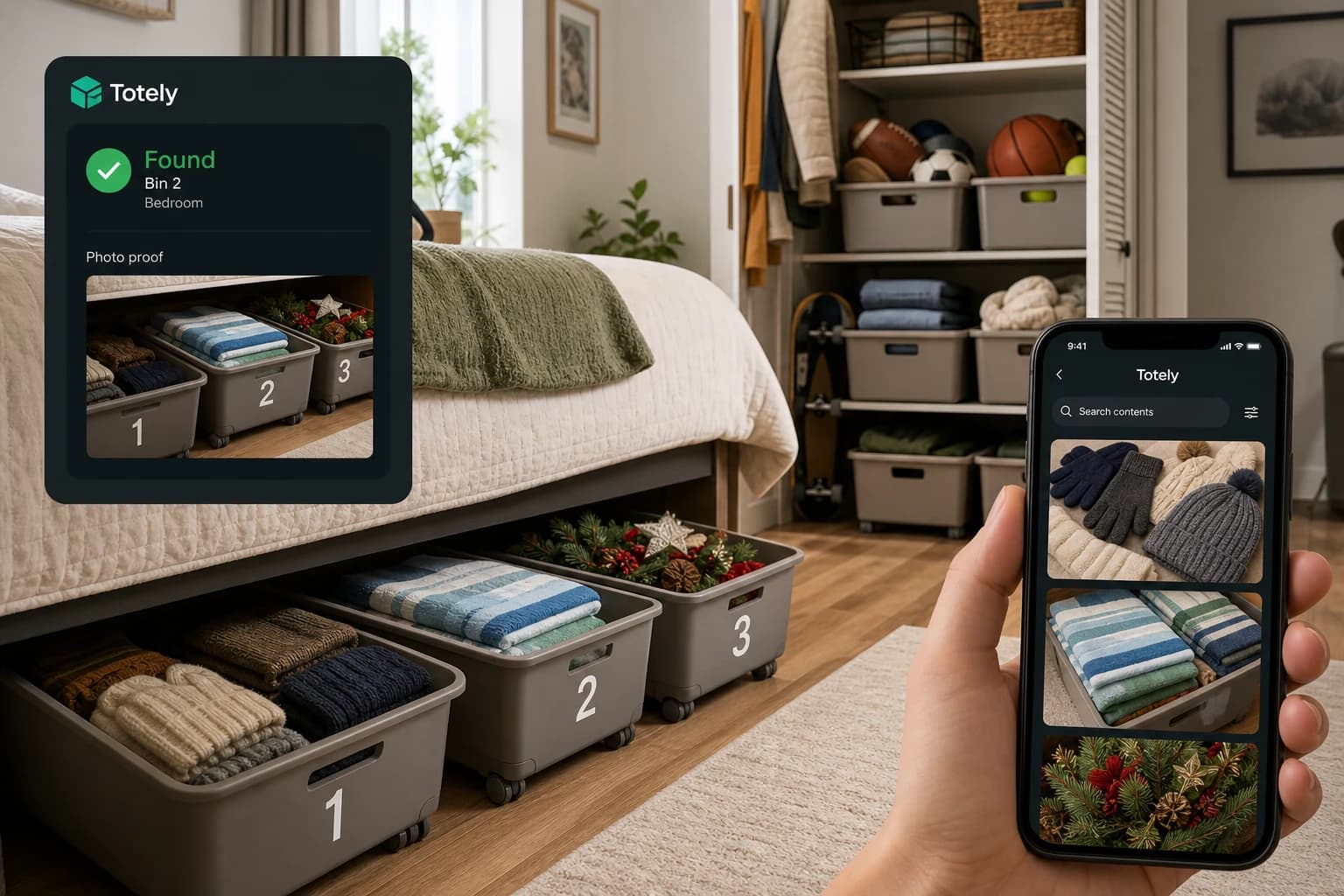
Seasonal storage is different in a small home.
There is no giant basement shelf, spare garage wall, or walk-in storage room waiting to absorb everything you only use a few months a year. Instead, seasonal items get tucked into real-life places: under-bed bins, closet top shelves, hallway closets, storage ottomans, cabinets, benches, rolling carts, shared basement corners, or one carefully managed storage unit.
That is why seasonal storage ideas for small homes need to be more specific than "buy more bins."
In a compact space, the real challenge is not just storing winter coats, gloves, hats, scarves, boots, snow pants, beach towels, swimsuits, pool floats, sunscreen, picnic blankets, sports gear, holiday decor, wrapping supplies, guest linens, extra blankets, seasonal shoes, rain gear, camping gear, school-year items, summer toys, winter bedding, and seasonal kids' clothing.
The challenge is remembering where everything lives when the season changes.
A small home needs rotation, not bulk storage. It needs compact containers, clear zones, simple numbers, photo records, and a way to search for the one item you need without pulling apart every closet.
Here is how to make seasonal storage work when your storage is spread across the whole home.
Quick Links
- Start With Seasonal Rotation, Not More Containers
- Use Under-Bed Bins for Low-Access Seasonal Items
- Turn Closets Into Small Seasonal Zones
- Separate Current Season From Off-Season Storage
- Avoid One Giant Seasonal Bin
- Store Seasonal Items by Retrieval Moment
- Make Renter-Friendly Seasonal Storage Portable
- Use Numbered Bins When Storage Is Spread Out
- How Totely Makes Seasonal Storage Searchable
- Seasonal Storage Ideas FAQs
Start With Seasonal Rotation, Not More Containers
Small homes usually do not need more containers first.
They need a smarter rotation.
Seasonal rotation means the items you use now get the easiest access, while off-season items move into lower-access spaces. Your winter coats, boots, gloves, hats, scarves, and snow pants should not fight for the same everyday space as swimsuits, beach towels, pool floats, picnic blankets, and summer toys.
Think of your home in two layers:
Current season: easy to reach, easy to grab, easy to put back. Off-season: protected, compact, numbered, photographed, and stored out of the way.
This simple shift keeps your everyday living space from becoming storage space.
Instead of trying to store every season equally, let the current season "come forward." When winter arrives, winter gear moves to the entry closet, hallway closet, closet floor bins, or storage bench. Summer gear moves under the bed, to a top shelf, or into a storage ottoman. When summer returns, swap them.
Good seasonal rotation is less about decluttering and more about timing.
The items you need now should be close. The items you need later should still be findable.
Use Under-Bed Bins for Low-Access Seasonal Items
Under-bed storage is one of the best small-home tools because it uses space you already have.
It works especially well for soft, flat, or low-access seasonal items: winter bedding, guest linens, extra blankets, seasonal shoes, scarves, hats, gloves, swimsuits, beach towels, holiday linens, school-year keepsakes, and seasonal kids' clothing.
Use shallow bins that slide easily. If the bin is hard to pull out, you will avoid using it. If it is too deep, small items will sink to the bottom and disappear.
Under-Bed Winter Bin
Gloves, hats, scarves, base layers, snow pants, winter socks, seasonal kids' clothing.
Under-Bed Summer Bin
Swimsuits, beach towels, picnic blanket, sun hats, pool float patches, lightweight coverups.
Under-Bed Guest Bin
Guest linens, extra pillowcases, seasonal blankets, spare towels, small guest supplies.
Before storing clothing or linens, make sure they are clean and fully dry. Real Simple notes that items like clothing, linens, outdoor essentials, and storage containers themselves should be cleaned before being stored so dirt, moisture, and odors do not sit all season.
For bulky items, vacuum bags can help in tight spaces, but use them carefully. They can be useful for some thick, soft items, but they are not ideal for everything. Delicate textiles, structured coats, down items, leather, or pieces that should not be over-compressed may need breathable storage or gentler folding. Always follow care labels for clothing, bedding, and specialty items.
Small homes reward compact storage, but not at the cost of damaging the things you are trying to protect.
Turn Closets Into Small Seasonal Zones
A small closet works better when it has zones.
Instead of letting the top shelf, floor, rod, and side corners become a mix of every season, give each area a purpose.
Small Closet Seasonal Zones
Top shelf
Low-access seasonal bins, holiday decor, beach gear, extra blankets, guest linens.
Closet floor
Current-season shoes, boots, rain gear, sports bag, or kids' seasonal accessories.
Hanging space
Current-season coats, jackets, and frequently worn layers.
Door or side storage
Gloves, hats, scarves, umbrellas, sunscreen, small bags, or grab-and-go items.
Closet zones are especially useful for apartments and rentals because they do not require permanent changes. Use renter-friendly shelves, stackable bins, hanging organizers, shelf dividers, or low rolling carts if they fit your space.
A hallway closet might become your rotating seasonal hub. In winter, it holds boots, coats, gloves, and scarves. In summer, it shifts to beach towels, picnic blankets, rain gear, sunscreen, and outdoor toys.
The trick is to avoid turning every closet into a tiny storage unit.
Each closet should answer one question clearly: What seasonal job does this closet do?
Separate Current Season From Off-Season Storage
One common small-space mistake is mixing current-season and off-season items in the same bin.
That sounds efficient, but it usually creates friction.
If your winter gloves are in the same bin as beach towels, every seasonal swap becomes a dig. If holiday decor shares space with summer toys, you have to disturb one season to reach another. If guest linens are mixed with winter bedding, the bin gets opened more often than it should.
Separate current-season items from off-season storage whenever possible.
Current-season items should be stored in the place you actually use them: entry closet, hallway closet, bedroom closet, mudroom corner, rolling cart, or storage bench.
Off-season items can go into lower-access spaces: under-bed bins, closet top shelves, storage ottomans, upper cabinets, shared basement storage, or storage unit shelves.
This is where small homes benefit from shallow bins and smaller containers. One giant seasonal bin might seem space-saving, but it forces you to open everything for one item. Smaller seasonal bins let you rotate only what is needed.
A small home works best when seasonal storage is modular.
Avoid One Giant Seasonal Bin
A giant bin labeled "seasonal" feels tidy for about five minutes.
Then it becomes a mystery box.
It might hold winter coats, beach towels, holiday decor, rain gear, wrapping supplies, extra blankets, school-year items, seasonal shoes, sunscreen, and camping gear. Everything is technically seasonal, but nothing is easy to find.
A better system is to make each bin specific enough to be useful.
Winter Gear Bin
Gloves, hats, scarves, snow pants, winter socks, base layers, hand warmers.
Summer and Beach Bin
Beach towels, swimsuits, sun hats, pool float repair patches, picnic blanket, sunscreen backup.
Holiday and Wrapping Bin
Small holiday decor, gift tags, tape, ribbon, bows, wrapping supplies.
Guest and Linen Bin
Guest sheets, extra blankets, pillowcases, seasonal quilts, spare towels.
Kids' Seasonal Clothing Bin
Next-size clothing, out-of-season layers, boots, seasonal pajamas, school-year items.
This does not mean you need dozens of bins. It means each bin should have one clear reason to exist.
Small spaces do not have room for mystery.
For holiday-specific packing, see how to organize Christmas decorations in storage bins and how to organize holiday decor by room, theme, and season.
Store Seasonal Items by Retrieval Moment
A retrieval moment is the situation when you will need the item again.
This is more useful than organizing only by category.
For example, "winter" is a category. "First cold snap" is a retrieval moment. When the first cold week arrives, you need gloves, hats, scarves, winter coats, boots, snow pants, and maybe extra blankets quickly.
"Summer" is a category. "Beach day" is a retrieval moment. When that moment comes, you need beach towels, swimsuits, sunscreen, water shoes, a picnic blanket, and pool toys.
"Holiday" is a category. "Wrapping gifts" is a retrieval moment. That calls for wrapping paper, tape, bows, ribbon, gift tags, scissors, and Christmas cards.
Use retrieval moments to decide what belongs together.
First Cold Week Bin
Gloves, hats, scarves, warm socks, snow pants, kids' winter layers.
Beach Day Bin
Beach towels, swimsuits, sunscreen, pool toys, picnic blanket, water shoes.
Guest Visit Bin
Guest linens, extra blankets, towels, pillowcases, spare toiletries.
School-Year Reset Bin
Backpacks, school papers, lunch boxes, seasonal uniforms, sports forms, school-year extras.
This makes storage feel less like hidden inventory and more like future planning.
Make Renter-Friendly Seasonal Storage Portable
Renters need seasonal storage that does not depend on built-ins, drilling, or permanent systems.
The best renter-friendly seasonal storage is portable, modular, and easy to move.
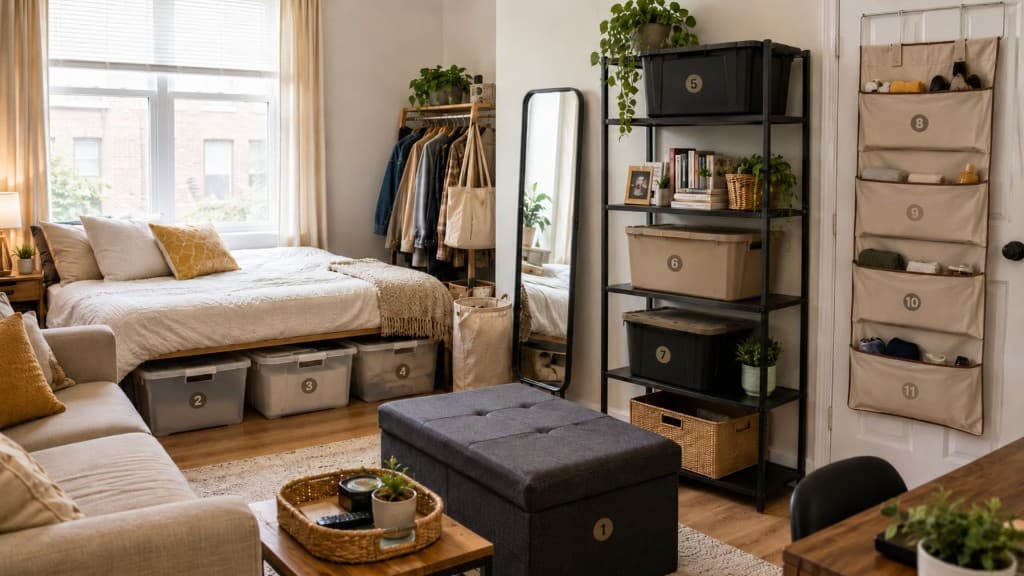
Good options include under-bed bins, lidded stackable bins, storage ottomans, storage benches, rolling carts, over-door organizers, freestanding shelves, shallow closet bins, and lightweight numbered totes.
Renter-Friendly Seasonal Storage
Storage Ottoman
Best for extra blankets, guest linens, winter throws, or small off-season soft goods.
Storage Bench
Best near an entry for shoes, gloves, hats, scarves, rain gear, or kids' seasonal accessories.
Rolling Cart
Best for small seasonal items that rotate often, such as sunscreen, bug spray, mittens, hats, school-year supplies, or wrapping tools.
Freestanding Shelf
Best for closets, shared basement areas, or storage units where you need vertical storage without permanent installation.
If you use a shared basement, shared garage, or storage unit, keep seasonal bins clearly numbered and easy to identify. Store the items you will need soon near the front. Avoid burying winter gear behind summer items right before cold weather starts.
If balcony or outdoor storage is allowed where you live, use it cautiously and only for items that can handle temperature, moisture, and local rules. Textiles, papers, photos, delicate holiday items, and anything moisture-sensitive usually do better indoors.
See renter storage organization for a portable system that works when you move.
Use Numbered Bins When Storage Is Spread Out
Small-home storage often fails because everything is stored in different places.
Winter bedding might be under the bed. Holiday decor might be on the closet shelf. Beach gear might be in a storage bench. Rain gear might be in the entry closet. Camping gear might be in a shared basement. Guest linens might be in an ottoman.
None of that is wrong.
But it becomes hard to manage if the only record is your memory.
This is where numbered bins help.
Use simple numbers:
1 2 3 4
Then connect each number to what is inside and where it lives.
Bin 1 Location: Under bed, left side Contents: winter hats, gloves, scarves, snow pants, kids' winter layers
Bin 2 Location: Hall closet top shelf Contents: holiday decor, wrapping supplies, gift tags, ribbon, tape
Bin 3 Location: Storage ottoman Contents: guest linens, extra blankets, pillowcases
Bin 4 Location: Entry closet floor Contents: rain gear, seasonal shoes, umbrellas, boots
Bin 5 Location: Shared basement shelf Contents: beach towels, picnic blanket, pool floats, summer toys
The number gives each container a stable identity. The record gives it context.
That way, your storage can be spread out without becoming invisible.
See storage tote labels that work and how to keep track of storage bins for numbered systems that stay trustworthy across seasons.
How Totely Makes Seasonal Storage Searchable
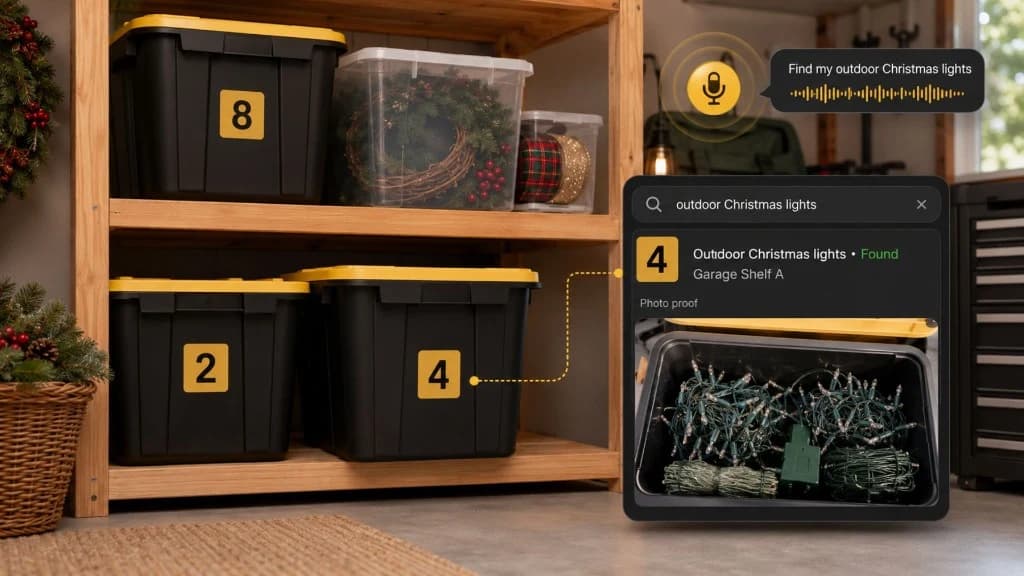
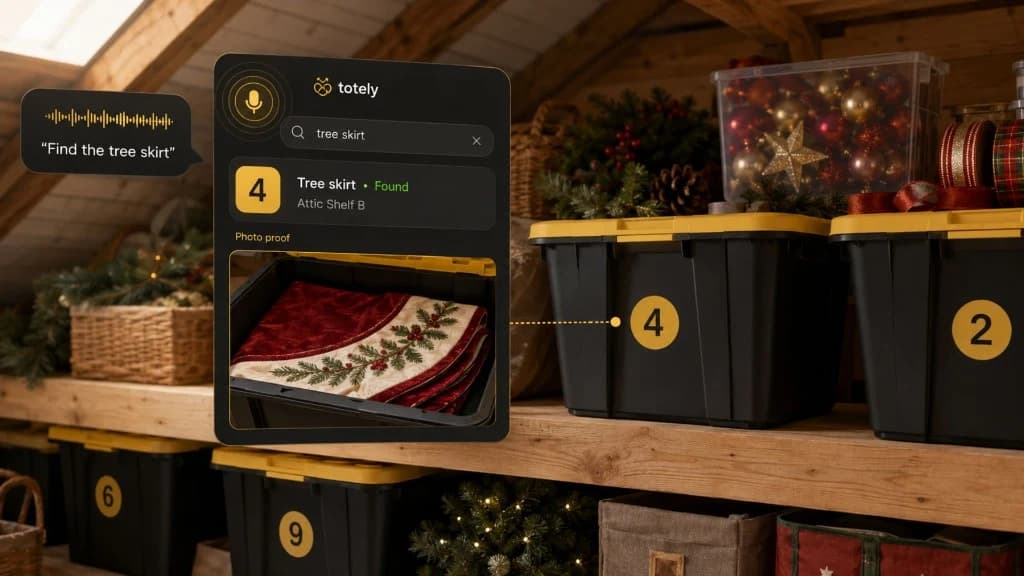
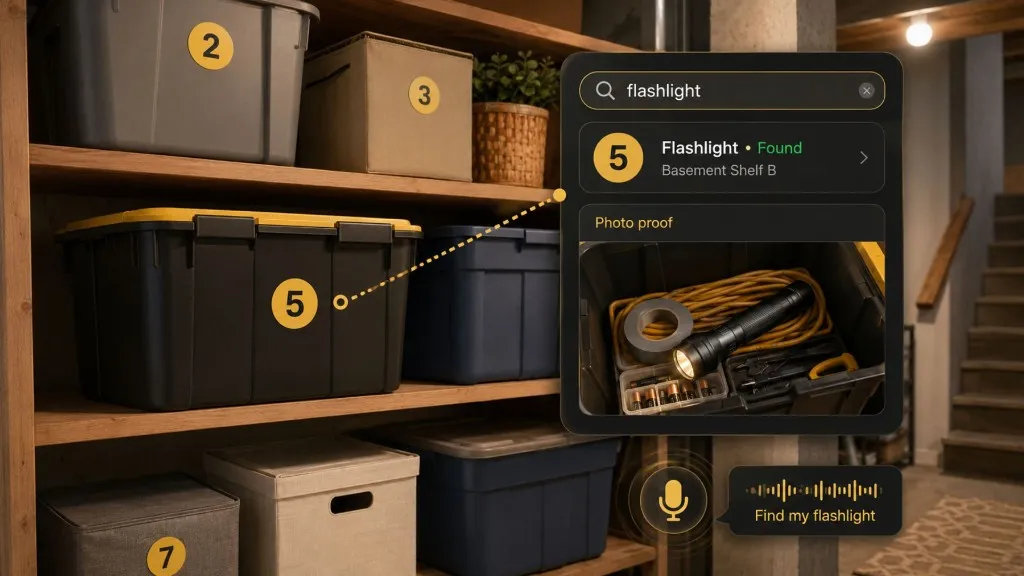
Totely is built for the exact small-home storage problem: seasonal items are often stored in several different places, and memory alone is not enough.
With Totely, you can make seasonal bins, totes, shelves, closets, under-bed containers, and storage zones searchable.
Here is the simple flow:
Number the seasonal bin, tote, shelf, closet zone, under-bed bin, or storage zone
so it has a clear identity.
Snap a photo
of what is inside.
Let AI build the first item list
from what it can see.
Review or edit if needed
so the words match how your household searches.
Save the location
such as "under bed left side," "hall closet top shelf," "entry closet floor," or "storage unit front shelf."
Search naturally later
for "winter gloves," "beach towels," "guest linens," "holiday ribbon," "snow pants," "rain boots," "camping gear," or "school-year clothes."
Use photo proof
to confirm what is inside before opening the container.
Totely does not replace care labels, textile preservation, renter rules, storage-unit rules, or safety guidance.
It simply helps you remember where each off-season item lives.
Think of it as the digital memory layer for compact storage.
See the seasonal gear storage use case for a full walkthrough, or try the One-Tote Test on one seasonal bin before you expand the system.
A Small-Home Seasonal Storage System You Can Copy
Here is a simple seasonal storage layout that works well for small homes and apartments.
A Small-Home Seasonal Storage System You Can Copy
Under-Bed Bin 1: Winter Gear
Gloves, hats, scarves, snow pants, base layers, winter socks, seasonal kids' clothing.
Under-Bed Bin 2: Summer and Beach Gear
Beach towels, swimsuits, pool floats, sunscreen backup, picnic blanket, summer toys.
Hall Closet Top Shelf: Holiday and Wrapping
Small holiday decor, wrapping supplies, gift tags, ribbon, bows, tape, Christmas cards.
Entry Closet Floor: Current Season Grab-and-Go
Boots, rain gear, umbrellas, seasonal shoes, winter accessories, or summer outdoor items.
Storage Ottoman: Guest and Linen Overflow
Guest linens, extra blankets, winter bedding, spare pillowcases, seasonal throws.
Rolling Cart: Seasonal Small Items
Sunscreen, bug spray, mittens, hats, school-year supplies, packing lists, small-space backstock.
Shared Basement or Storage Unit Bin: Low-Access Seasonal Gear
Camping gear, patio cushions if appropriate, sports gear, off-season decorations, larger seasonal items.
If that feels like too much, start with one container.
Number it. Take a photo. Save the location. Make it searchable.
Small homes do not need perfect systems. They need systems that are easy enough to keep using.
Seasonal Storage Ideas FAQs
What are the best seasonal storage ideas for small homes?
The best seasonal storage ideas for small homes focus on rotation, not bulk storage. Use under-bed bins, closet zones, storage ottomans, benches, rolling carts, stackable bins, and numbered containers so off-season items stay out of the way but easy to find later.
How do I store seasonal items without a garage?
Use compact indoor storage such as under-bed bins, closet top shelves, hallway closet zones, storage benches, ottomans, shallow bins, rolling carts, and freestanding shelves. If you use a shared basement, shared garage, or storage unit, keep the most seasonal items near the front and number each container.
What should I store under the bed?
Under-bed bins work well for low-access seasonal items such as winter hats, gloves, scarves, snow pants, swimsuits, beach towels, guest linens, extra blankets, seasonal shoes, school-year keepsakes, and seasonal kids' clothing. Use shallow bins that slide easily and photograph what is inside before storing them.
How do I organize seasonal clothes in a small apartment?
Keep the current season in your main closet and move off-season clothes to under-bed bins, top shelves, storage ottomans, or a secondary closet. Clean and fully dry clothing before storage, avoid over-compressing delicate items, and group clothes by retrieval moment, such as "first cold week," "beach trip," or "guest visit."
How do I keep track of seasonal bins in different places?
Use simple numbered bins and save each bin's contents and location. For example, Bin 1 might be under the bed with winter gear, Bin 2 might be on the hall closet shelf with holiday supplies, and Bin 3 might be in a storage ottoman with guest linens.
How can Totely help with seasonal storage?
Totely helps you number seasonal bins, snap photos, let AI build the first item list, review or edit if needed, save the exact location, and search naturally later. Photo proof helps you confirm what is inside before opening every bin.
Make Seasonal Swaps Easier in a Small Home
Seasonal storage in a small home should not make your home feel smaller.
It should help each season take its turn.
Keep current-season items close. Move off-season items into compact, protected spaces. Use under-bed bins, closet shelves, ottomans, benches, rolling carts, and renter-friendly storage. Avoid one giant seasonal bin. Number each container. Save what is inside and where it lives.
With Totely, seasonal storage becomes searchable, so you can find winter coats, gloves, beach towels, swimsuits, guest linens, holiday decor, rain gear, camping gear, and seasonal kids' clothing without unpacking every corner of your home.
Start with one seasonal bin.
Give it a number. Snap a photo. Save the location. Make the next seasonal swap easier before it arrives.