Garage Organization With Bins: A Step-by-Step System
Learn how to organize a garage with bins using simple numbers, photo records, shelf zones, and item search so storage stays findable.
By Steve Watts · Co-Founder, Totely
May 15, 2026 · Updated June 6, 2026 · 15 min read
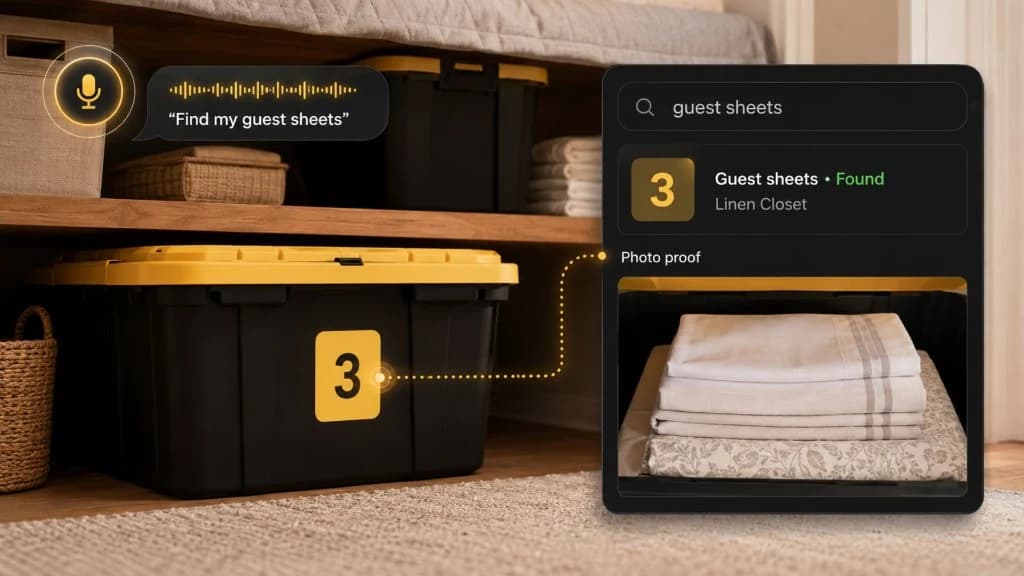
Garage bins can make a messy garage look better fast.
You clear the floor, sort a few piles, put everything into totes, stack them on a shelf, and suddenly the garage feels calmer.
Then a few months pass.
Someone needs batteries, extension cords, tape, work gloves, garden gloves, sprinkler parts, a flashlight, holiday lights, tent stakes, headlamps, bike accessories, or the one tool you know you own. The bins are stacked neatly, but the labels are vague. One says "tools." Another says "garage." Another says "seasonal." One might not have a label at all.
That is the problem with garage organization with bins: bins make the garage look cleaner, but without zones, visible numbers, photos, and exact locations, they can quickly become mystery boxes.
A better garage bin system does two jobs at once. It gives every item a sensible physical home, and it gives every bin a simple way to be found later.
Here is a step-by-step system for organizing a garage with bins so the space stays useful after projects, holidays, camping trips, sports seasons, and everyday family life.
Quick Links
- Why Garage Bins Become Mystery Bins
- Step 1: Sort the Garage by Zone, Not by Panic
- Step 2: Decide What Belongs in Bins
- Step 3: Give Every Garage Bin a Visible Number
- Step 4: Photograph What Is Inside Each Bin
- Step 5: Record the Exact Shelf or Garage Location
- Step 6: Avoid Miscellaneous Garage Bins
- Step 7: Keep the Garage Bin System Updated
- Garage Bin Examples by Zone
- How Totely Makes Garage Bins Searchable
- Garage Organization With Bins FAQs
Why Garage Bins Become Mystery Bins
Garages are mixed-use spaces.
They hold tools, hardware, sports gear, camping gear, garden supplies, car care products, holiday decorations, household backstock, seasonal decor, outdoor gear, cords, batteries, paint supplies, cleaning supplies, and sometimes overflow from inside the house.
That variety is exactly why garage bins become confusing.
A bin labeled "garage stuff" might hold extension cords, hooks, bungee cords, sprinkler parts, work gloves, tape, and small tools. A bin labeled "seasonal" might hold holiday lights, Christmas decorations, beach gear, winter gear, folding chairs, or sports accessories. A bin labeled "tools" might hold actual tools, or it might hold hardware, batteries, drill bits, flashlight parts, and half-used tape.
The issue is not that bins are bad. The issue is that broad labels do not survive real garage life.
Contents change after projects. Gear gets pulled out and returned to the wrong place. Holiday items get packed quickly. Camping gear comes home dirty, wet, or missing pieces. Kids' sports gear moves in and out with the season. Household backstock gets added wherever there is space.
A garage bin system only works long-term if it can handle change. For broader garage layout ideas, see garage storage ideas for totes and bins and the garage organization guide.
Step 1: Sort the Garage by Zone, Not by Panic
Do not start by buying more bins.
Start by giving the garage practical zones.
A zone is a dedicated area for a type of use. Instead of creating piles that simply say "keep" and "store," think about what people come into the garage to do.
Useful garage zones include:
Tool and Hardware Zone Tools, fasteners, small hardware, work gloves, tape, batteries, drill bits, measuring tools.
Cords and Utility Zone Extension cords, power strips, chargers, adapters, hooks, bungee cords, rope, zip ties.
Garden and Yard Zone Garden gloves, sprinkler parts, hose attachments, small hand tools, plant supplies.
Sports and Outdoor Zone Sports balls, helmets, bike accessories, beach gear, folding chairs, outdoor games.
Camping and Adventure Zone Camping gear, tent stakes, headlamps, lanterns, ground tarp, camp kitchen items.
Holiday and Seasonal Zone Holiday lights, Christmas decorations, wreath hooks, seasonal decor, winter gear.
Household Backstock Zone Paper goods, spare light bulbs, storage supplies, small overflow items.
This is more useful than sorting by panic, where everything gets thrown into bins just to clear the floor.
Car and Driver points out that real organization is about creating a system, not just cleaning up, and warns against relying only on floor space or using bins without a plan.
A garage zone gives every bin a job.
Step 2: Decide What Belongs in Bins
Not everything in a garage belongs in a bin.
Bins are great for groups of smaller items that need to stay together, especially if they are seasonal, dusty, awkward, or easy to lose.
Good bin items include batteries, tape, extension cords, work gloves, sprinkler parts, hose attachments, bike accessories, sports balls, camping gear, tent stakes, headlamps, lanterns, holiday lights, Christmas decorations, seasonal decor, beach gear, winter gear, household backstock, and small overflow items.
But some items work better elsewhere.
Long-handled tools may belong on wall hooks. Frequently used sports balls may belong in an open basket. Bikes may belong on racks. Sharp tools may belong in a cabinet or tool chest. Heavy items should usually stay low. Large items like folding chairs may work better on wall hooks or a dedicated shelf.
Better Homes & Gardens notes that boxing up frequently used outdoor toys can create an extra retrieval step, making it less likely that items get returned properly.
That idea applies to the whole garage.
Use bins for things that need containment. Use wall storage, shelves, pegboards, cabinets, racks, and floor zones for things that need visibility or quick access.
Step 3: Give Every Garage Bin a Visible Number
Once you know which items belong in bins, number each bin clearly.
Use large, simple numbers:
1 2 3 4
Put the number where you can actually see it. If bins are stacked on shelves, label the front-facing side, not just the lid. If bins are stored high, make the number large enough to read from below. If bins sit under a workbench, label the side that faces out.
You can add a short zone note if it helps.
Bin 5 — Garage Quick Repair Bin 6 — Camping First Open Bin 7 — Garden Parts Bin 8 — Holiday Lights
But avoid writing long lists on the outside. Long labels become outdated when contents change.
The number is the stable identity. The detailed contents live in the searchable record.
See how to label storage bins and storage tote labels that work for why numbers beat long exterior labels when garage life keeps changing contents.
Step 4: Photograph What Is Inside Each Bin
Before you close a garage bin, take a photo of what is inside.
This step matters most for opaque bins, stacked bins, and bins stored on high shelves. Once a lid is closed, memory starts doing too much work.
A photo can show whether the bin has extension cords, batteries, tape, flashlights, work gloves, bungee cords, sprinkler parts, or small hardware. It can show whether the camping bin holds tent stakes, headlamps, lanterns, ground tarp, or camp kitchen items. It can show whether the holiday bin holds outdoor lights, Christmas decorations, wreath hooks, replacement bulbs, or seasonal decor.
If a bin has inner bags or small organizers, photograph those too.
For example:
Photo 1: Full bin before closing. Photo 2: Small hardware pouch. Photo 3: Cord and battery bag. Photo 4: Fragile or seasonal items that need extra care.
The goal is not a perfect inventory photo.
The goal is photo proof before digging.
Step 5: Record the Exact Shelf or Garage Location
A garage bin record needs an exact location.
"Garage" is not enough if you have shelves, wall racks, cabinets, overhead storage, a workbench, and floor zones.
Use specific location language:
Garage shelf, top row Garage shelf, bottom row Left wall rack, Bin 4 Workbench cabinet, right side Back wall storage rack Garage shelf, middle row, left side Overhead shelf, lightweight seasonal bins
This matters because bins move.
Holiday decor may move from a low shelf to a high shelf after the season. Camping gear may come forward in summer. Sports gear may move lower during soccer season. Household backstock may shift to make room for a project.
When you record exact locations, you do not have to remember the whole garage map.
You can search for the item and know where to look.
Use this simple record format:
Outside label: Bin #
Optional zone note: Garage zone / shelf / use case
Searchable record: Bin number: Location: Photo: Key contents: Notes:
Example:
Outside label: Bin 5 — Garage Quick Repair
Searchable record: Bin number: 5 Location: Garage shelf, bottom row Photo: Contents before closing Key contents: batteries, extension cords, tape, flashlight, work gloves, bungee cords, small hardware Notes: Restock tape and AA batteries
For a full tracking workflow, see keep track of storage bins and garage storage inventory.
Step 6: Avoid Miscellaneous Garage Bins
A miscellaneous garage bin is just a future mystery bin.
Sometimes mixed bins happen. That is normal. But instead of labeling something "misc," name the retrieval moment.
A retrieval moment is the reason someone will look for those items later.
Bad: Misc garage
Better: Quick repair supplies — batteries, tape, work gloves, flashlight, extension cords, small tools.
Bad: Outdoor stuff
Better: Garden and sprinkler parts — garden gloves, sprinkler parts, hose attachments, plant ties.
Bad: Seasonal
Better: Holiday lights and hooks — outdoor lights, Christmas decorations, wreath hooks, replacement bulbs.
Bad: Camping
Better: Camping first-open setup — tent stakes, headlamps, lanterns, ground tarp, camp kitchen items.
Bad: Tools
Better: Small hardware and measuring tools — drill bits, fasteners, measuring tape, hooks, tape.
This works because garage items are often used in clusters. If someone needs to fix something quickly, they may need batteries, tape, work gloves, flashlight, extension cords, and small tools together. If someone is setting up the yard, they may need garden gloves, sprinkler parts, hose attachments, and plant ties together.
Group by use, not just category.
Step 7: Keep the Garage Bin System Updated
A garage bin system does not need constant maintenance.
It needs small updates at the right moments.
Update garage bins after:
Household projects When tools, hardware, tape, batteries, extension cords, hooks, and small parts get used or moved.
Holidays When holiday lights, Christmas decorations, extension cords, replacement bulbs, wreath hooks, and seasonal decor are packed away.
Camping trips When camping gear, tent stakes, headlamps, lanterns, repair kits, and folding chairs come back. See how to organize camping gear in storage totes for a packing workflow that makes updates easier.
Sports seasons When sports balls, helmets, bike accessories, beach gear, and outdoor games rotate in or out.
Garden season When garden gloves, sprinkler parts, hose attachments, plant supplies, and small hand tools change.
Seasonal swaps When winter gear, beach gear, seasonal decor, and household backstock move to different shelves.
The update should be quick: open the bin, snap a new photo if needed, adjust the key contents, and confirm the location.
If updating feels like a chore, the system will fall behind. Keep it light.
Garage Bin Examples by Zone
Use these examples as a starting point for your own garage.
Garage Bin Examples by Zone
Tool and Hardware Zone
Small hardware, drill bits, measuring tape, work gloves, batteries, tape, hooks, fasteners.
Cords and Utility Zone
Extension cords, power strips, chargers, adapters, rope, zip ties, bungee cords, hooks.
Garden and Yard Zone
Garden gloves, sprinkler parts, hose attachments, plant ties, seed packets, small hand tools.
Sports and Outdoor Zone
Sports balls, helmets, bike accessories, beach gear, folding chairs, outdoor games.
Camping and Adventure Zone
Camping gear, tent stakes, headlamps, lanterns, ground tarp, dry bags, camp kitchen items.
Holiday and Seasonal Zone
Holiday lights, Christmas decorations, wreath hooks, seasonal decor, winter gear.
Household Backstock Zone
Paper goods, spare light bulbs, household backstock, small appliances, overflow storage supplies.
For paint supplies, cleaning supplies, fuel, propane, batteries, chemicals, and similar items, use cautious storage. Follow product labels, manufacturer instructions, local rules, and safety guidance. Good Housekeeping warns that garages can be unsuitable for items like paint, gasoline, oily rags, electronics, paper, photos, clothing, linens, and some other materials because of temperature, moisture, pests, and safety concerns.
Totely can help you remember where items are stored, but it does not replace safety guidance or proper handling.
How Totely Makes Garage Bins Searchable
Totely helps with the part of garage organization that usually breaks down: remembering what is inside each bin after life changes.
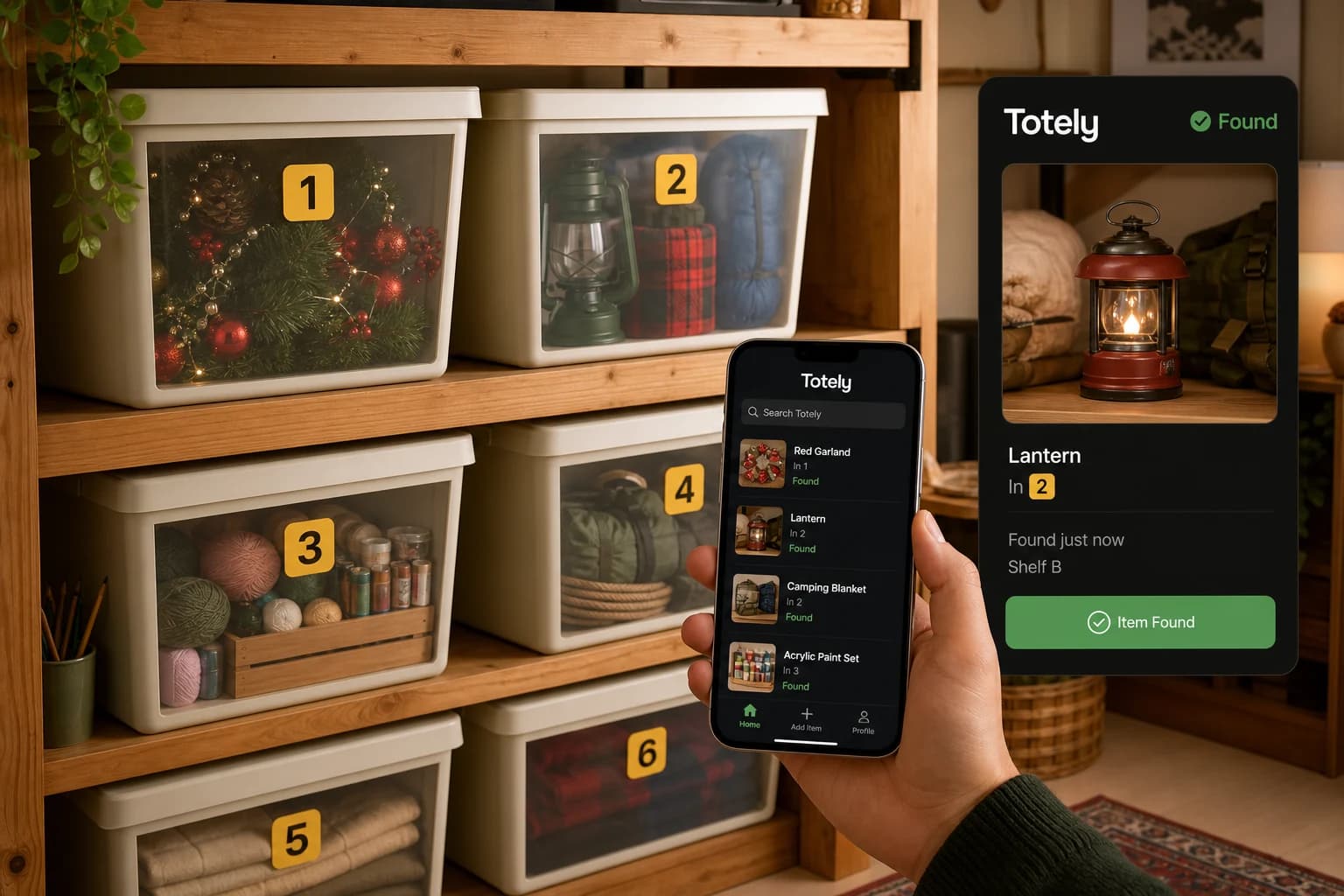
Instead of relying on vague labels or memory, Totely helps you make garage bins, totes, shelves, and zones searchable.
Here is the simple flow:
Sort garage items into zones
so tools, garden supplies, camping gear, holiday decor, sports gear, and backstock each have a logical home.
Number each garage bin, tote, shelf, or storage zone
so it has a clear identity.
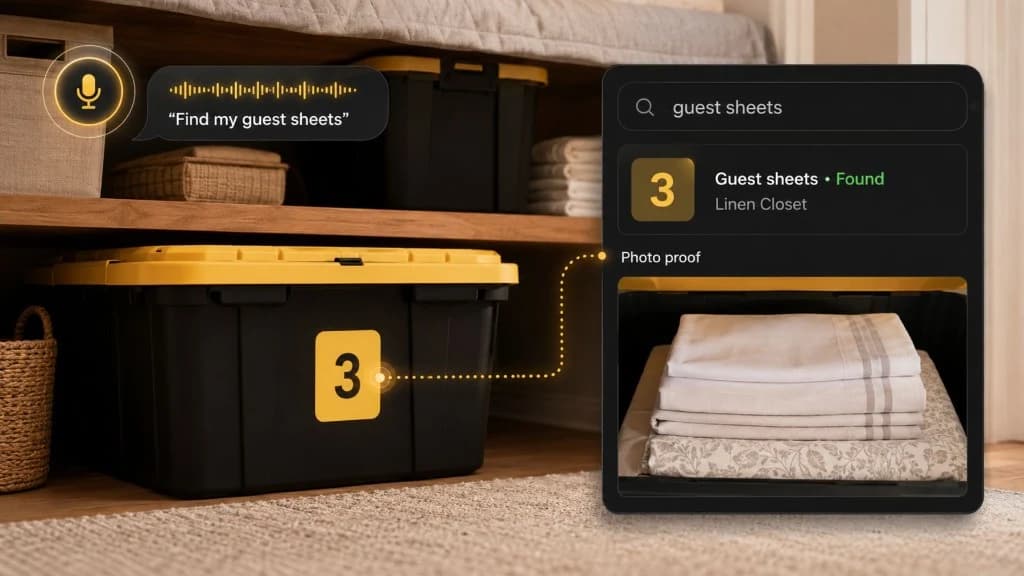
Snap a photo before closing the bin
so you have visual proof of what is inside.
Let AI build the first item list
from what it can see.
Review or edit if needed
so the words match how your household searches.
Save the exact garage location
such as "left wall shelf, top row," "garage shelf bottom row," "workbench cabinet," or "back wall storage rack."
Add notes
like "restock batteries," "check cords," "holiday," "camping first open," "fragile," or "seasonal."
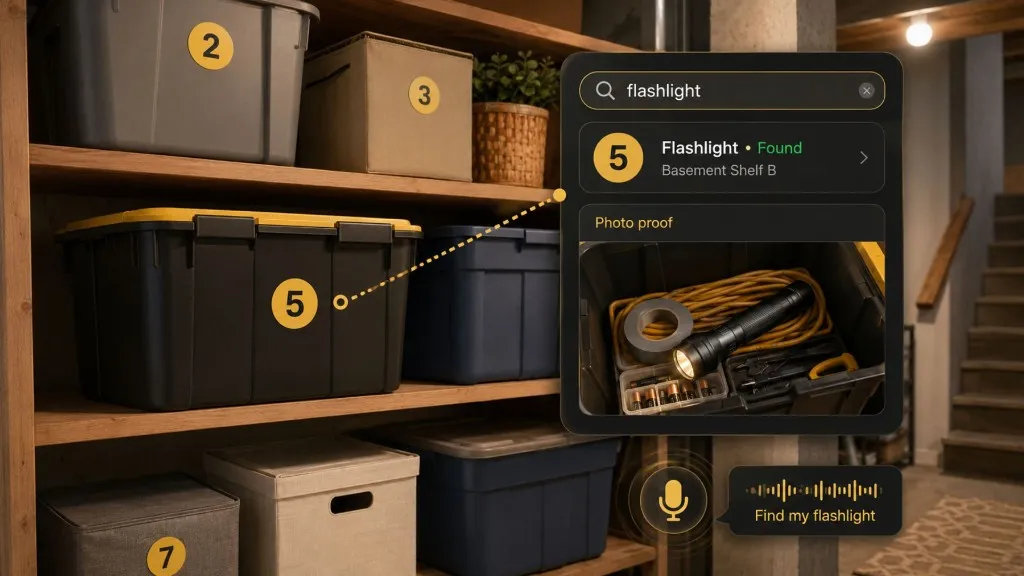
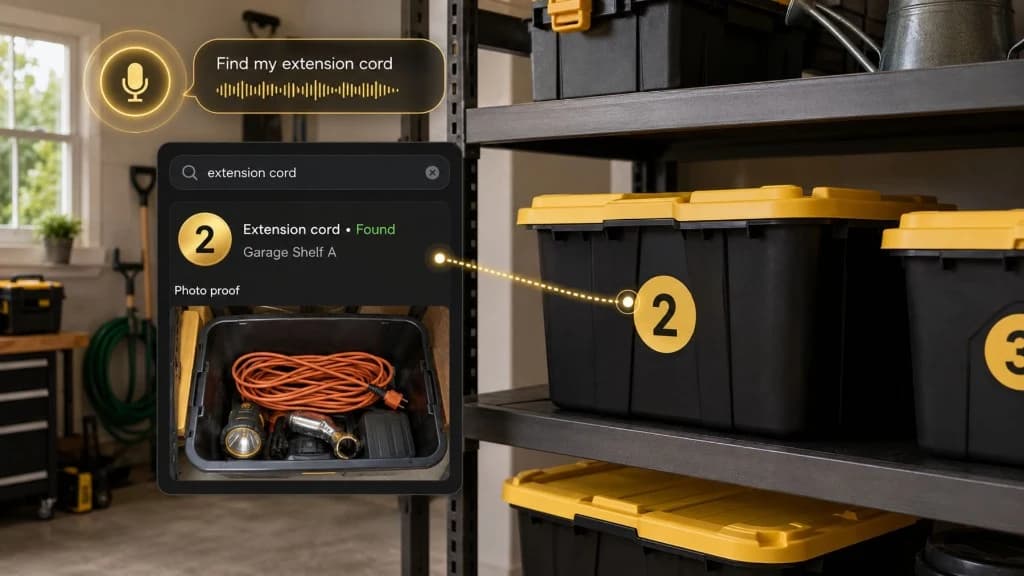
Search naturally later
for "extension cords," "tent stakes," "holiday lights," "garden gloves," "sprinkler parts," "batteries," or "bike accessories."
Use photo proof
to confirm what is inside before opening every bin.
Totely does not require QR codes, barcodes, or manual entry of every item.
Garage organization with bins only works long-term if the bins stay findable after life changes. Totely reduces the maintenance friction by helping you number each bin, snap one photo, save the garage location, and search naturally later.
Try the One-Tote Test on one garage shelf, or see garage storage inventory for a full use-case walkthrough.
A Garage Organization System You Can Copy
Here is a practical garage bin system you can adapt.
A Garage Organization System You Can Copy
Bin 1 — Garage Quick Repair
Location: Garage shelf, bottom row. Contents: batteries, extension cords, tape, flashlight, work gloves, bungee cords, small hardware. Notes: Restock tape and AA batteries.
Bin 2 — Cords and Utility
Location: Left wall shelf, middle row. Contents: extension cords, power strips, chargers, adapters, hooks, rope, zip ties. Notes: Check cords before seasonal use.
Bin 3 — Garden and Sprinkler Parts
Location: Back wall storage rack. Contents: garden gloves, sprinkler parts, hose attachments, plant ties, small hand tools. Notes: Bring forward in spring.
Bin 4 — Sports and Bike Gear
Location: Garage shelf, lower row. Contents: sports balls, helmets, bike accessories, pump needle, beach gear. Notes: Keep easy for kids to reach.
Bin 5 — Camping First Open
Location: Garage shelf, middle row. Contents: camping gear, tent stakes, headlamps, lanterns, ground tarp, repair kit. Notes: Restock batteries before next trip.
Bin 6 — Holiday and Seasonal
Location: Garage shelf, top row. Contents: holiday lights, Christmas decorations, wreath hooks, seasonal decor, replacement bulbs. Notes: Lightweight seasonal bin only.
Bin 7 — Household Backstock
Location: Workbench cabinet, right side. Contents: spare light bulbs, household backstock, paper goods, storage supplies, small overflow items. Notes: Check before buying duplicates.
This system gives each bin a visible number, a garage zone, a photo, a location, key searchable contents, and a simple update note.
That is enough structure to keep the garage useful without turning it into an admin project.
Garage Organization With Bins FAQs
What is the best way to organize a garage with bins?
The best way to organize a garage with bins is to sort items into practical garage zones, decide what belongs in bins versus wall storage or shelves, number each bin, photograph the contents, save the exact shelf location, and keep the record updated when contents change.
How should I label garage storage bins?
Use a large visible number on each garage bin and add a short zone note only if it helps, such as "Garage Quick Repair," "Camping First Open," or "Garden Parts." Keep detailed contents in a searchable record instead of writing long lists on the outside.
What should go in garage bins?
Garage bins work well for contained groups like batteries, extension cords, tape, work gloves, garden gloves, sprinkler parts, hose attachments, car cleaning supplies, bike accessories, sports gear, camping gear, tent stakes, holiday lights, seasonal decor, and household backstock. Items used constantly or awkwardly shaped may work better on hooks, shelves, racks, pegboards, cabinets, or open bins.
How do I keep garage bins from becoming miscellaneous bins?
Group garage bins by retrieval moment instead of vague categories. For example, create a quick repair bin, garden parts bin, camping first-open bin, holiday lights bin, and sports gear bin instead of using labels like "misc," "garage," or "seasonal."
How do I track what is inside garage bins?
Give each bin a number, take a photo of the contents, record key searchable items, and save the exact garage location. Update the record after projects, holidays, camping trips, sports seasons, seasonal swaps, or when items are added or removed.
How can Totely help with garage organization with bins?
Totely helps you number garage bins, snap photos, let AI build the first item list, review or edit if needed, save exact garage locations, add useful notes, and search naturally later. Photo proof helps you confirm what is inside before opening every bin.
Make Garage Storage Findable, Not Just Tidy
A tidy garage is nice.
A findable garage is better.
Bins can clear the floor and calm the visual mess, but the real win is knowing exactly where the batteries, extension cords, work gloves, sprinkler parts, holiday lights, tent stakes, tools, sports gear, and camping gear live when you need them.
Start with one garage zone. Choose what belongs in bins. Number each bin. Photograph the contents. Save the shelf location. Keep the record searchable.
With Totely, your garage bins can stay organized after projects, seasons, family use, and everyday life.
Because the goal is not just to put things away.
It is to find them again.